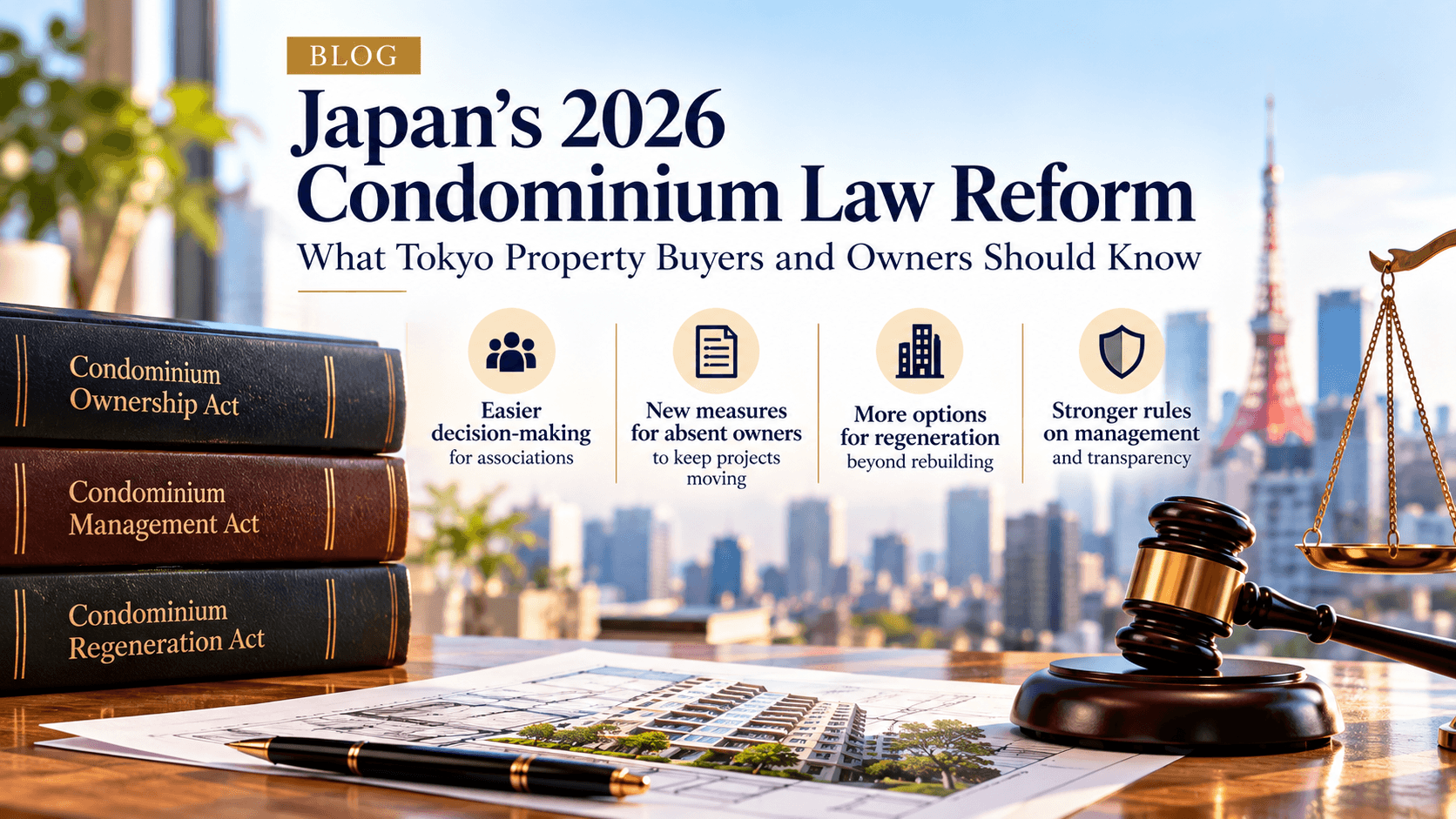


What Tokyo Property Buyers and Owners Should Know
On April 1, 2026, significant reforms to Japan’s condominium ownership, management and redevelopment framework came into effect.
The reforms cover several laws, including Japan’s Act on Building Unit Ownership and related legislation governing condominium management and regeneration.
But what has actually changed?
More importantly, what do these changes mean for people buying or already owning a condominium in Tokyo?
Why were the laws changed?
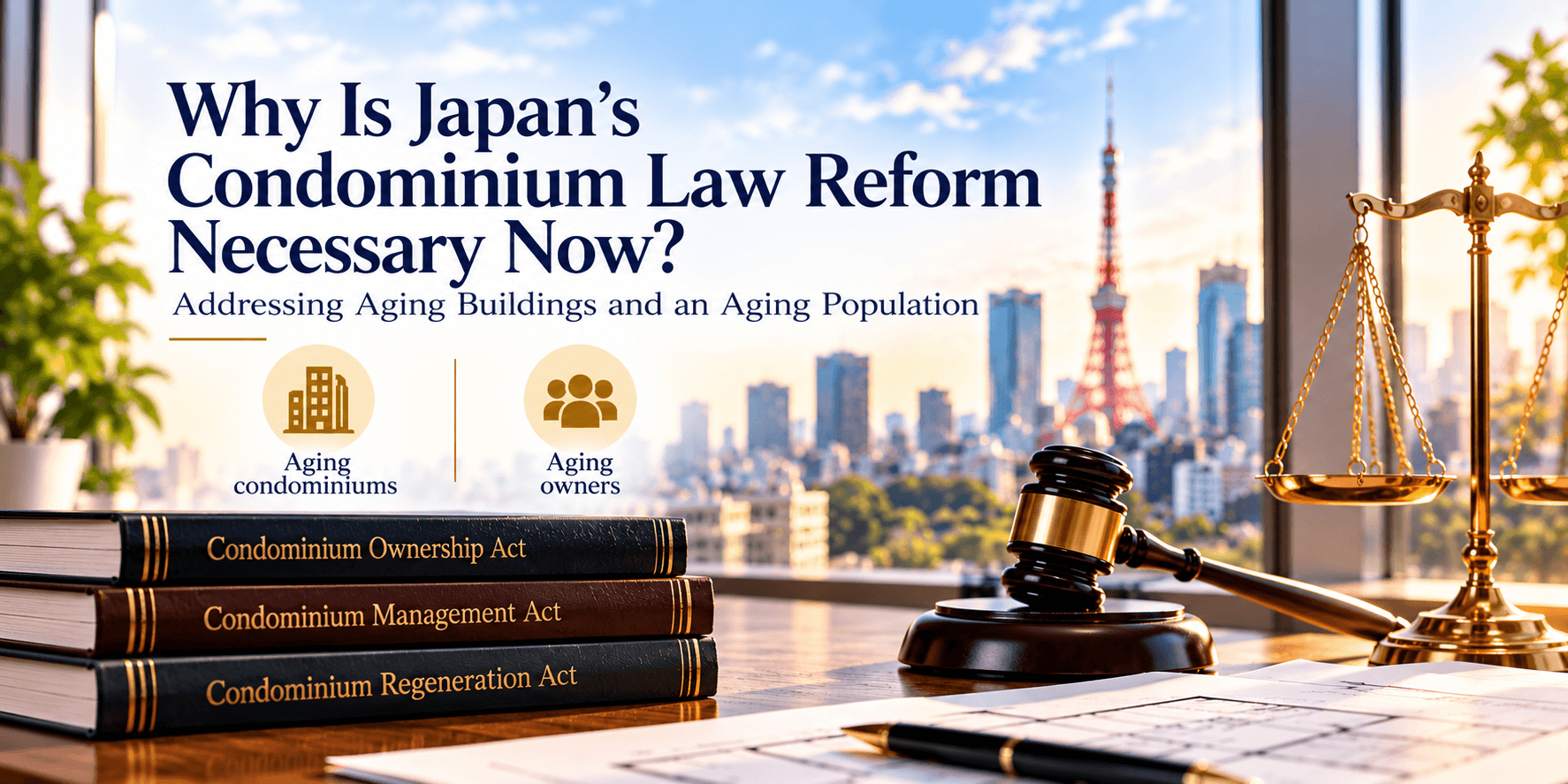
Japan is facing two simultaneous challenges: aging condominium buildings and aging unit owners.
According to Japan’s Ministry of Land, Infrastructure, Transport and Tourism, there are approximately 1.37 million condominium units in buildings over 40 years old.
That number is expected to approximately double over the next 10 years and increase to around 3.4 times its current level over the next 20 years.
As buildings age, decisions about major repairs, seismic upgrades, renovation and redevelopment become increasingly important.
At the same time, aging owners, inheritance issues and owners whose whereabouts are unknown can make it difficult for condominium associations to reach the decisions necessary to maintain a building.
The 2026 reforms are designed to make condominium management and regeneration more effective.
1. Easier decision-making for condominium associations

One important change concerns voting at condominium owners’ meetings.
For certain matters that do not involve the disposal of individual ownership rights, including ordinary management and repair matters, decisions can now generally be based on the owners and voting rights represented at the meeting rather than all unit owners.
A new mechanism also allows owners whose whereabouts have been judicially confirmed as unknown to be excluded from the denominator used for certain resolutions.
The objective is to prevent necessary management and repair decisions from becoming unnecessarily difficult simply because some owners cannot be contacted or do not participate.
2. More options for aging condominiums
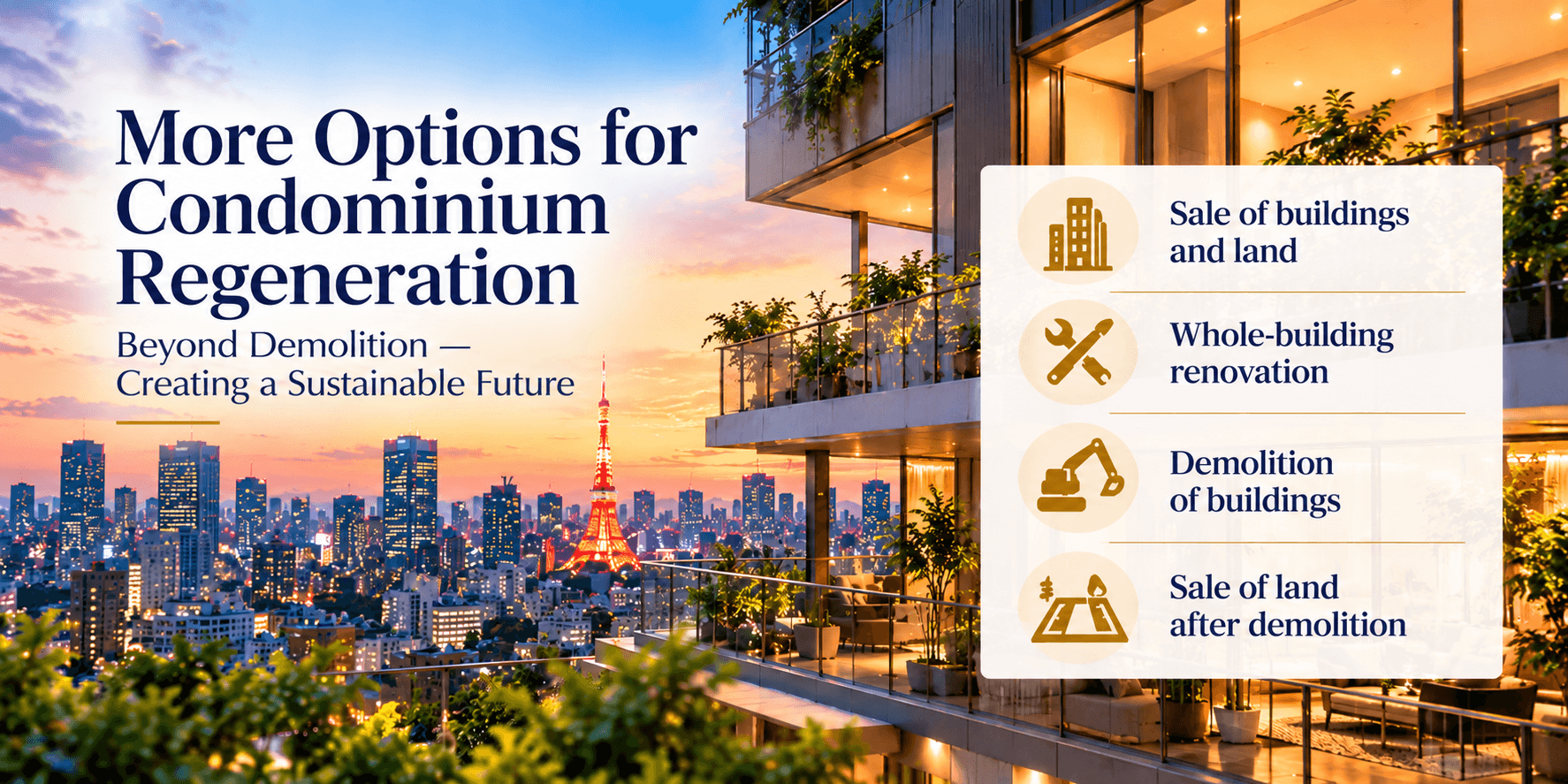
Traditionally, the future of an aging condominium was often discussed largely in terms of continuing repairs or complete reconstruction.
The new framework provides additional regeneration options.
These may include:
• Sale of the building and land as a whole
• Whole-building renovation
• Demolition of the building
• Sale of the land following demolition
Subject to the applicable statutory requirements, these options can be approved through collective decision-making by unit owners.
This gives aging condominium communities more ways to consider the future of their property.
3. Stronger measures against poor management
The reforms also introduce mechanisms under which a court-appointed administrator may manage certain poorly managed private or common areas.
Local governments have also been given stronger tools to respond to condominiums that have deteriorated to a potentially dangerous condition.
A condominium is not an asset that exists independently within the four walls of one apartment.
The condition and management of the entire building matter.
4. Greater attention to conflicts of interest in management
Japan has seen increasing use of management structures in which a condominium management company also acts as the administrator or representative of the owners’ association.
This can create potential conflicts of interest when the same company is involved in transactions or construction work on behalf of the condominium.
The revised framework therefore introduces disclosure requirements for certain transactions involving such potential conflicts.
For buyers, this means it is increasingly important to understand not only which company manages the building, but also how the condominium association itself is governed.
What does this mean for foreign and overseas owners?
These changes are also relevant to foreign nationals and owners living outside Japan.
For an overseas owner, participating in owners’ meetings, exercising voting rights, communicating with the management company and reviewing important documents can be more difficult.
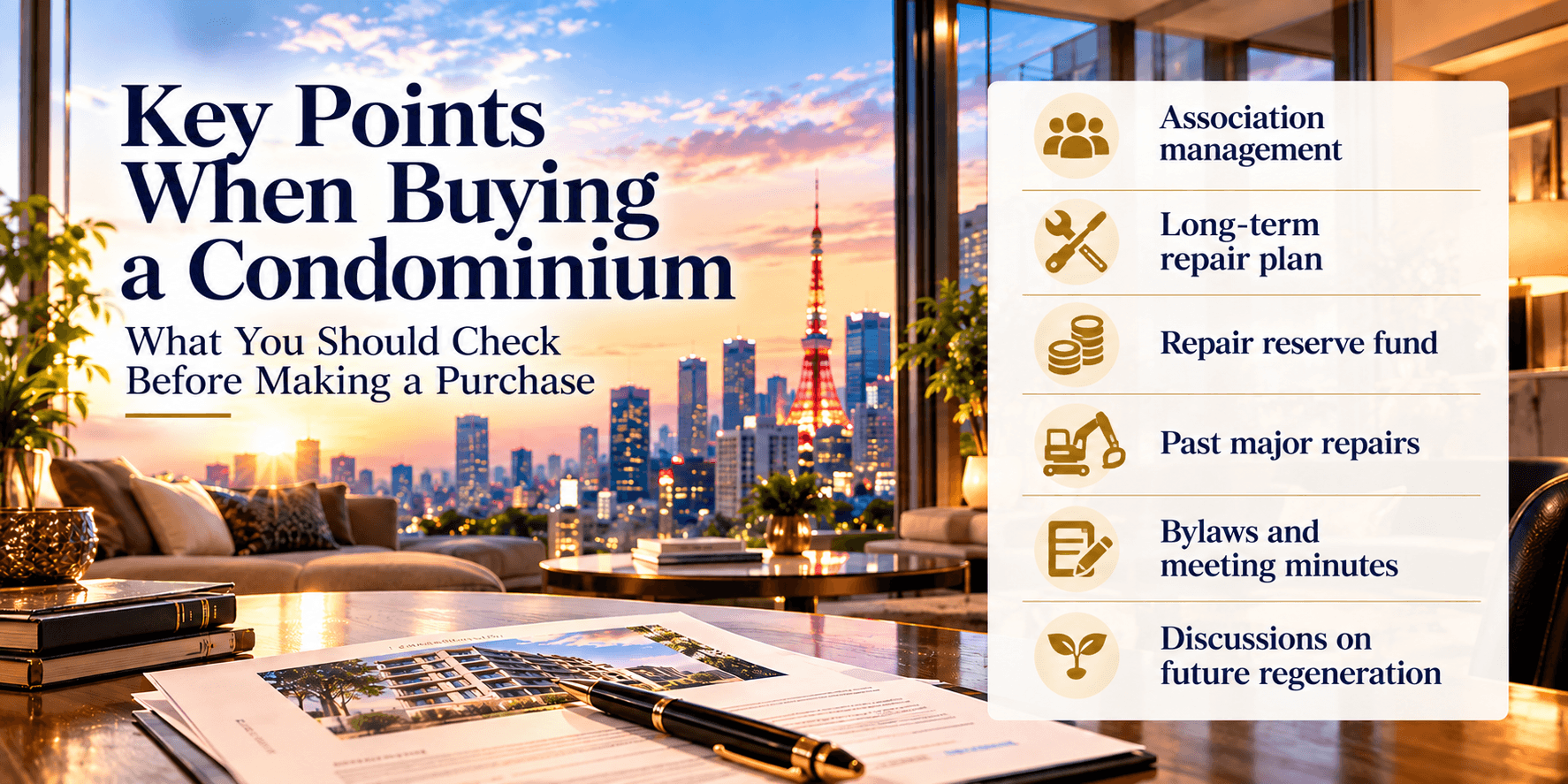
When purchasing a condominium in Tokyo, therefore, it is important to look beyond the apartment itself.
Consider reviewing:
• How the owners’ association is managed
• The long-term repair plan
• The balance and adequacy of the repair reserve fund
• Previous major repair works
• Planned future repairs
• Condominium bylaws
• Minutes of owners’ meetings
• Any discussions concerning future redevelopment or regeneration
Do not judge a condominium by age alone
Imagine two condominium buildings that are both 30 years old.
One has been properly maintained, has an adequately funded repair reserve and an active owners’ association.
The other has postponed necessary repairs, has insufficient reserves and struggles to reach important decisions.
Both may be described simply as “30 years old.”
But they are clearly not the same property.
When evaluating a resale condominium in Tokyo, it is therefore important to:
Look at the building.
Look at the management.
And look at its future.
A new perspective on buying resale condominiums in Tokyo

The 2026 reforms are not simply about making it easier to demolish aging buildings.
They are part of a broader effort to improve long-term condominium management, facilitate necessary repairs and create more practical options for regeneration.
For anyone considering a resale condominium in Tokyo, location, price, size, views and building age remain important.
But management quality and the building’s long-term future should also be part of the investment decision.
Asian Property supports international clients with the purchase, sale, leasing and management of real estate in Tokyo, including clients who live outside Japan.
If you are considering buying or owning property in Tokyo, please feel free to contact us.
ASIAN PROPERTY CO., LTD.
Tokyo Real Estate Insight
This article is intended for general informational purposes and is based on laws and publicly available information as of September 2026. It does not constitute individual legal or tax advice.
Schedule a Free Consultation or Property Viewing
→ Contact Form
Receive Exclusive Property Updates & Special Campaigns
→ Newsletter Signup